A Global Blueprint for People, Planet, Prosperity, Peace and Partnership
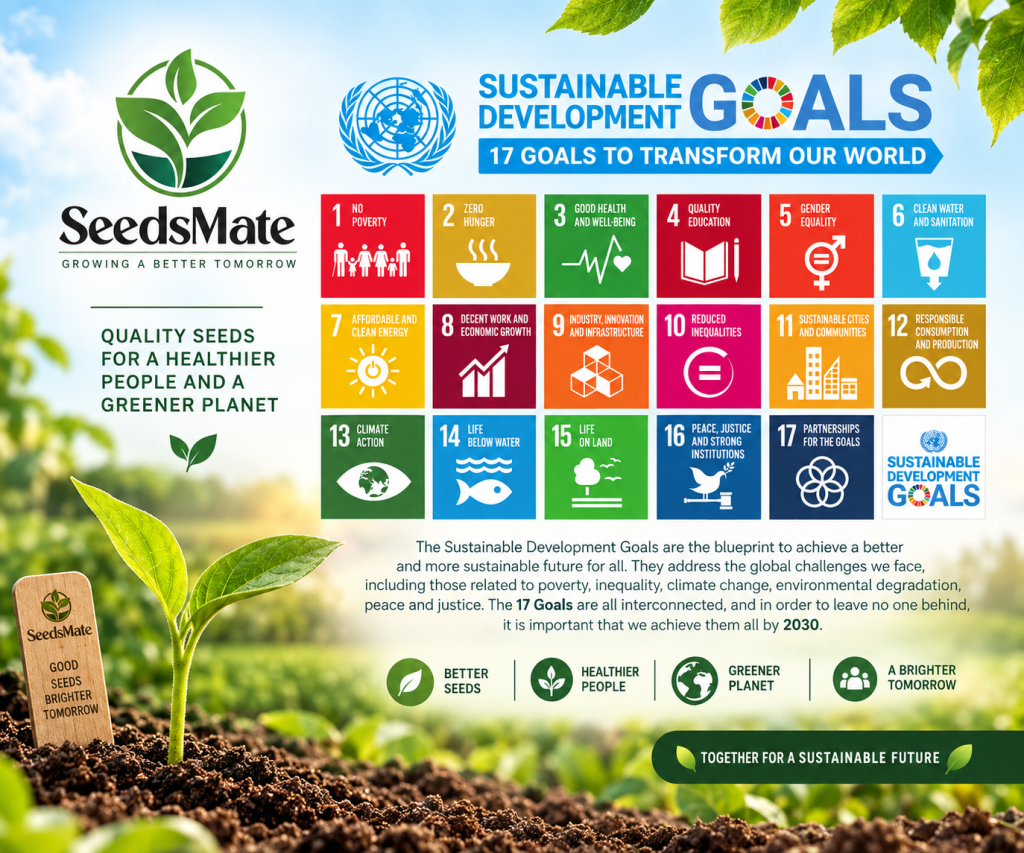
The Sustainable Development Goals (SDGs) are a global framework designed to create a more peaceful, prosperous, inclusive, and sustainable future for everyone. Adopted by all United Nations Member States in 2015 as part of the 2030 Agenda for Sustainable Development, the 17 SDGs address some of the world’s most important challenges—including poverty, hunger, inequality, climate change, environmental degradation, health, education, and sustainable economic development.
The 17 Sustainable Development Goals are interconnected. Progress in one area can support progress in many others. From improving food security and supporting farmers to protecting biodiversity and addressing climate change, sustainable agriculture has an important role to play in achieving the SDGs.
At SeedsMate, we believe that better seeds can contribute to healthier crops, stronger food systems, and a greener future.
What Are the Sustainable Development Goals?
The Sustainable Development Goals, commonly known as SDGs or Global Goals, consist of 17 goals and 169 targets intended to guide global development through 2030.
They provide a shared framework for governments, businesses, organizations, communities, farmers, and individuals to work toward a more sustainable world.
The 17 SDGs cover five broad areas:
-
- People — ending poverty and hunger and improving health, education, and equality.
-
- Planet — protecting natural resources, ecosystems, biodiversity, and the climate.
-
- Prosperity — creating sustainable economic growth and opportunities.
-
- Peace — promoting peaceful, just, and inclusive societies.
-
- Partnership — strengthening cooperation to achieve sustainable development.
The 17 Sustainable Development Goals
1. No Poverty
Goal 1: End poverty in all its forms everywhere.
Poverty remains one of the world’s major development challenges. Sustainable economic opportunities, access to resources, decent employment, and resilient agricultural systems can help communities improve their livelihoods.
For farming communities, productive agriculture and access to quality inputs can contribute to stronger household income and greater economic resilience
2. Zero Hunger
Goal 2: End hunger, achieve food security and improved nutrition, and promote sustainable agriculture.
Food security is closely connected to agriculture. Farmers need access to quality seeds, knowledge, technology, water, soil resources, and markets to produce nutritious food sustainably.
Quality seeds can play an important role in productive and resilient food systems, helping farmers grow vegetables, fruits, grains, and other crops that contribute to food availability and nutrition.
SeedsMate supports the broader vision of sustainable agriculture by making quality seeds accessible to farmers, gardeners, and growers.
3. Good Health and Well-Being
Goal 3: Ensure healthy lives and promote well-being for all at all ages.
Healthy communities depend on access to nutritious food, clean environments, healthcare, and safe living conditions.
Sustainable agriculture can contribute to healthier food systems by encouraging the production of diverse fruits and vegetables and promoting responsible agricultural practices.
Growing nutritious food at home, in gardens, or through commercial farming can also help communities become more connected to the food they consume.
4. Quality Education
Goal 4: Ensure inclusive and equitable quality education and promote lifelong learning opportunities for all.
Education is fundamental to sustainable development.
Agricultural education can help farmers and growers understand seed selection, crop management, soil health, water conservation, pest management, climate resilience, and sustainable farming practices.
Sharing reliable agricultural knowledge can empower farmers to make better decisions and improve productivity while protecting natural resources.
5. Gender Equality
Goal 5: Achieve gender equality and empower all women and girls.
Women play important roles in agriculture, food production, household nutrition, entrepreneurship, and rural economies.
Creating equal opportunities for women to access education, financial resources, agricultural technologies, markets, and decision-making can strengthen families and communities.
Sustainable development requires the meaningful participation of everyone.
6. Clean Water and Sanitation
Goal 6: Ensure availability and sustainable management of water and sanitation for all.
Water is essential for agriculture and human life. Sustainable farming requires responsible water management and efficient irrigation practices.
Farmers can help protect water resources through methods such as efficient irrigation, soil moisture management, rainwater harvesting, mulching, and responsible agricultural input use.
Healthy agriculture depends on healthy water systems.
7. Affordable and Clean Energy
Goal 7: Ensure access to affordable, reliable, sustainable, and modern energy for all.
Sustainable energy can help communities reduce environmental impacts while supporting economic development.
Agriculture can benefit from renewable energy technologies such as solar-powered irrigation, solar agricultural equipment, and energy-efficient farming systems.
The transition toward cleaner energy can contribute to more resilient and sustainable food production.
8. Decent Work and Economic Growth
Goal 8: Promote sustained, inclusive and sustainable economic growth, full and productive employment, and decent work for all.
Agriculture creates livelihoods for millions of people around the world.
A stronger agricultural sector can support farmers, seed producers, agricultural workers, retailers, logistics providers, food businesses, and rural entrepreneurs.
Supporting responsible businesses and sustainable agricultural value chains can help create economic opportunities while building resilient communities.
9. Industry, Innovation and Infrastructure
Goal 9: Build resilient infrastructure, promote inclusive and sustainable industrialization, and foster innovation.
Innovation is transforming modern agriculture.
From improved seed varieties and digital farming tools to smart irrigation, protected cultivation, precision agriculture, and climate-resilient farming techniques, innovation can help farmers respond to changing agricultural challenges.
At SeedsMate, we recognize that innovation and access to quality agricultural resources are important components of the future of farming.
10. Reduced Inequalities
Goal 10: Reduce inequality within and among countries.
Sustainable development should create opportunities for people regardless of their economic or social circumstances.
Improving access to agricultural knowledge, quality seeds, technology, markets, and entrepreneurial opportunities can help reduce barriers faced by smallholder farmers and rural communities.
An inclusive food system benefits everyone.
11. Sustainable Cities and Communities
Goal 11: Make cities and human settlements inclusive, safe, resilient, and sustainable.
Sustainability is not limited to rural areas.
Urban gardening, rooftop gardens, community gardens, balcony farming, and local food production can bring agriculture into cities while encouraging greener communities.
Urban agriculture can contribute to food awareness, biodiversity, community engagement, and more sustainable lifestyles.
12. Responsible Consumption and Production
Goal 12: Ensure sustainable consumption and production patterns.
Responsible production means using resources efficiently and reducing unnecessary waste.
In agriculture, sustainable production can include responsible seed selection, efficient use of water and nutrients, soil conservation, integrated pest management, waste reduction, and better post-harvest practices.
Consumers can also contribute by choosing locally produced food, reducing food waste, and supporting responsible agricultural businesses.
13. Climate Action
Goal 13: Take urgent action to combat climate change and its impacts.
Climate change is already affecting agriculture through changing temperatures, rainfall patterns, extreme weather, drought, flooding, and emerging pest and disease pressures.
Building climate-resilient agriculture is therefore essential.
Farmers can improve resilience through crop diversification, appropriate variety selection, soil health management, water conservation, protected cultivation, and sustainable farming practices.
A resilient seed and food system is an important part of preparing agriculture for a changing climate.
14. Life Below Water
Goal 14: Conserve and sustainably use the oceans, seas and marine resources.
Agriculture and water ecosystems are interconnected.
Responsible management of agricultural runoff, soil erosion, fertilizers, pesticides, and water resources can help reduce pressure on rivers, wetlands, coastal ecosystems, and marine environments.
Protecting water quality is essential for both people and nature.
15. Life on Land
Goal 15: Protect, restore and promote sustainable use of terrestrial ecosystems.
Healthy soil, forests, grasslands, biodiversity, and agricultural ecosystems are essential for life on Earth.
Sustainable agriculture can support land conservation through crop diversity, soil protection, organic matter management, responsible water use, biodiversity-friendly practices, and reduced environmental pressure.
Healthy soil is the foundation of sustainable food production.
16. Peace, Justice and Strong Institutions
Goal 16: Promote peaceful and inclusive societies, provide access to justice, and build effective, accountable institutions.
Sustainable development requires trust, transparency, fairness, and effective institutions.
Strong institutions can help create an environment where farmers, businesses, communities, and consumers can participate fairly in economic and social development.
Peace and stability are fundamental to long-term food and economic security.
17. Partnerships for the Goals
Goal 17: Strengthen the means of implementation and revitalize the global partnership for sustainable development.
No single organization can achieve the Sustainable Development Goals alone.
Governments, businesses, farmers, researchers, educators, communities, NGOs, and consumers all have a role to play.
Partnership is at the heart of sustainable development.
By sharing knowledge, technology, resources, and innovation, communities can build stronger and more sustainable agricultural and food systems.
How Sustainable Agriculture Supports the SDGs
Agriculture is directly connected to many of the Sustainable Development Goals.
Sustainable farming can contribute to:
-
- Zero Hunger (SDG 2) through food production and food security.
-
- Good Health (SDG 3) through nutritious food.
-
- Quality Education (SDG 4) through agricultural knowledge and training.
-
- Decent Work (SDG 8) through agricultural employment and entrepreneurship.
-
- Responsible Consumption and Production (SDG 12) through efficient resource use.
-
- Climate Action (SDG 13) through climate-resilient farming.
-
- Life on Land (SDG 15) through soil and biodiversity conservation.
-
- Partnerships (SDG 17) through collaboration across the agricultural value chain.
This interconnected approach demonstrates why sustainable agriculture is an important part of building a better future.
SeedsMate and a More Sustainable Agricultural Future
At SeedsMate, our vision is rooted in a simple idea:
Better Seeds. Healthier People. A Greener Planet.
Quality seeds are the starting point of successful crop production. When farmers and growers have access to suitable, quality planting materials and reliable agricultural information, they can make more informed decisions about what and how they grow.
SeedsMate aims to support a growing community of farmers, home gardeners, commercial growers, agricultural entrepreneurs, and gardening enthusiasts with quality seeds and practical agricultural resources.
Our broader sustainability perspective focuses on:
 Better Seeds
 Better Seeds
Helping growers access quality seeds suitable for their agricultural and gardening needs.
Greener Agriculture
 Greener Agriculture
Encouraging responsible and resource-conscious approaches to crop production.
Food Security
 Food Security
Supporting the production of vegetables, fruits, and other crops that contribute to diverse food systems.
Stronger Farming Communities
 Stronger Farming Communities
Sharing useful agricultural information that can help growers make better decisions.
A Better Tomorrow
Promoting a culture where agriculture, innovation, environmental responsibility, and community development move forward together.
What Can You Do to Support the Sustainable Development Goals?
Sustainable development is not only the responsibility of governments and large organizations. Individuals, families, farmers, businesses, and communities can all take action.
Here are some simple ways to contribute:
Grow something.
Start a vegetable garden, balcony garden, rooftop garden, or community growing project.
Reduce food waste.
Plan meals, store food properly, and use food responsibly.
Support local farmers.
Choose locally produced food and support responsible agricultural businesses.
Use water responsibly.
Adopt efficient irrigation and avoid unnecessary water waste.
Protect soil.
Use sustainable growing practices that help maintain soil health.
Plant for biodiversity.
Grow diverse crops and plants that support healthier ecosystems.
Learn and share.
Agricultural knowledge can help communities make more sustainable choices.
Why the SDGs Matter for Bangladesh
For #Bangladesh, sustainable development is closely connected to agriculture, food security, climate resilience, water management, rural livelihoods, biodiversity, and sustainable economic development.
As a densely populated country with a large agricultural sector and significant exposure to climate-related risks, Bangladesh has a strong interest in building resilient food and farming systems.
Farmers and growers can contribute to a more sustainable Bangladesh through efficient resource use, crop diversification, improved agricultural practices, soil conservation, responsible water management, and climate-resilient production.
From a small home garden to a commercial farm, every sustainable growing decision can be part of a larger movement toward a healthier future.
The Future Starts With What We Grow Today
The Sustainable Development Goals provide a shared vision for a better world by 2030. Achieving that vision requires action at every level—from international partnerships to everyday choices made by individuals and communities.
Agriculture has a unique role because it connects food, people, health, livelihoods, climate, water, soil, and biodiversity.
At SeedsMate, we believe the journey toward a sustainable future can begin with something as simple as a seed.
Plant today. Grow responsibly. Build a better tomorrow.
SeedsMate — Growing a Better Tomorrow.
Frequently Asked Questions About Sustainable Development Goals
What are the Sustainable Development Goals?
The Sustainable Development Goals (SDGs) are 17 interconnected global goals adopted by United Nations Member States in 2015 to promote sustainable development and guide action toward 2030.
How many Sustainable Development Goals are there?
There are 17 Sustainable Development Goals, covering social, economic, environmental, and institutional aspects of sustainable development.
Why are the SDGs important?
The SDGs provide a shared framework for addressing global challenges such as poverty, hunger, inequality, climate change, environmental degradation, health, education, and sustainable economic development.
What is the connection between agriculture and the SDGs?
Agriculture is strongly connected to food security, nutrition, employment, economic development, climate resilience, water management, responsible production, soil health, and biodiversity. Therefore, sustainable agriculture can contribute to multiple SDGs.
How can farmers contribute to the SDGs?
Farmers can contribute through sustainable crop production, responsible water use, soil conservation, crop diversification, efficient resource management, biodiversity protection, and climate-resilient agricultural practices.
How can individuals support sustainable development?
Individuals can reduce food waste, conserve water and energy, grow food, support local farmers, choose responsible products, protect biodiversity, and learn about sustainable living.
How does SeedsMate support sustainable agriculture?
SeedsMate focuses on providing quality seeds and agricultural information for farmers, growers, gardeners, and agricultural communities, while promoting the broader principles of responsible and sustainable crop production.